A Star Chart or a Written Landmark?
Compare a star chart with a written landmark, learn when each is useful and follow a clear route from a recognisable star to your target.
Should you bring a star chart or rely on a written landmark to find your way around the night sky? A star chart or written landmark can both help you orient yourself, but they answer different questions: a chart shows relationships across the sky, while a landmark note gives a route from something recognisable to your target.
You do not need a phone or specialist equipment for either approach. A printed chart, a notebook and a clear view of a few bright stars are enough to practise matching the sky to a simple map or description.
Two ways to orient
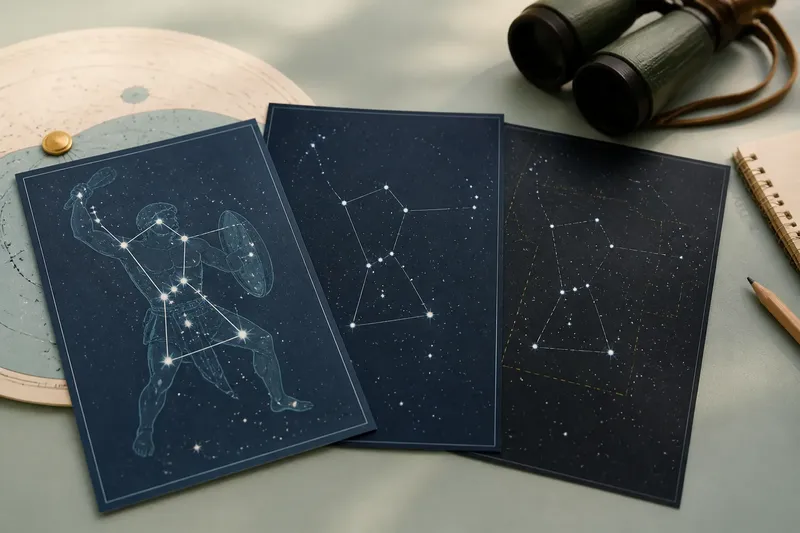
A star chart is a map of the sky for a particular time and place, or a simplified map of a constellation. It compresses a broad field of stars onto a page, letting you compare patterns, spacing and direction. A chart can answer, “What else is near this shape?”
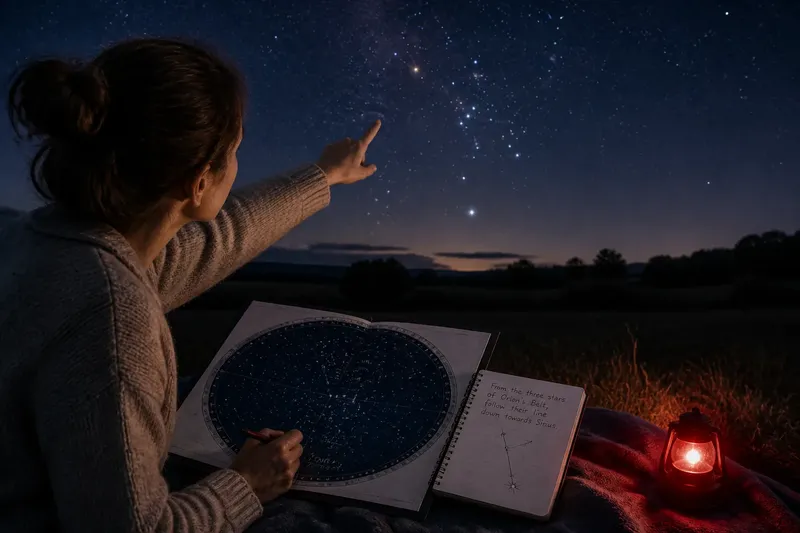
A written landmark is a brief verbal cue anchored to something you can already identify. For example: “Find the three stars in Orion’s Belt; follow their line down and left towards the bright star Sirius.” The cue names both a starting pattern and a direction to follow, rather than leaving you to guess what “nearby” means.
The difference is not between a sophisticated method and an easy one. A chart is more informative but asks you to interpret a map; a landmark note is quicker to consult but depends on its starting point being visible and correctly identified.
What a chart shows
Most printed sky charts use a circular or rectangular field, with stars drawn as points and brighter stars often shown with larger symbols. Constellation boundaries, names or connecting lines may also appear, but those lines are conventions rather than physical structures in space. Read the legend before using one, since symbol size and line styles vary.
Charts are especially useful when several patterns sit close together. They show how a target relates to its neighbours, which can help when clouds obscure one star or when a familiar outline looks unfamiliar from a different location. The page also gives you a view beyond the narrow patch named in a brief observing note.
There is a catch: a chart is a flattened view of a curved sky. Depending on its projection and the way it is held, directions on paper may not match the directions overhead. A chart made for a particular date and time can also be less useful if you consult it much earlier or later, because the sky appears to shift as the night progresses.
What landmarks provide
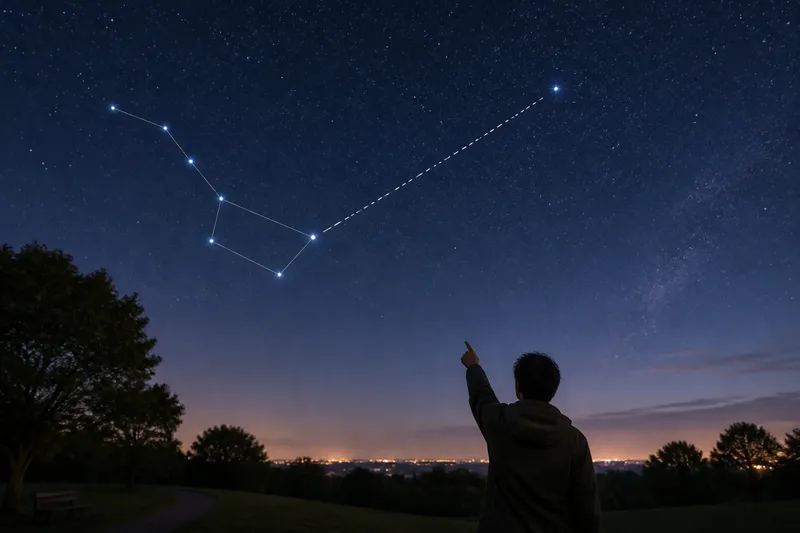
A landmark description can be as simple as: “Find the three stars of Orion’s Belt, then trace their line down towards Sirius, the bright star in Canis Major.” Its strength lies in reducing the search to one relationship at a time. You need not decode every symbol or scan a whole page to begin.
Good notes use visible, stable cues rather than vague instructions such as “look a little higher”. They name the starting pattern and describe a direction relative to it: towards a named horizon, away from a nearby bright star, or along an imaginary line between two recognisable points. Since the sky turns across the night, a direction based on a constellation or the horizon is more useful than one based on a page’s top edge.
Landmarks can fail when the starting star is hidden by a roof, tree or cloud, or when the note assumes a view from a different part of the world. A short description may also omit nearby patterns that would help you recover if you lose your place. In those moments, the chart’s wider context becomes valuable.
Choosing your starting point
Choose a chart when you want to understand a broad patch of sky, compare several neighbouring patterns or recover your bearings after losing a target. Choose landmark notes when you are learning one route at a time, sharing a simple direction with someone beside you or observing without wanting to handle a page in the dark.
Conditions matter. A bright Moon, haze or urban lighting can wash out fainter stars, so a complicated chart may show far more points than you can see. A landmark note that uses a few conspicuous stars may remain manageable, provided those stars are above your horizon and not blocked from your viewing place.
For a first outing, prepare a chart and a short note for the same area. The chart supplies context; the note tells you where to begin. Keep the page readable in dim light, and let your eyes adjust rather than repeatedly looking at a bright screen or lamp.
How do you use either method?
How should you hold a printed chart?
Hold it so the direction marked for the horizon you are facing is nearest that horizon, then compare the broad star pattern rather than demanding an exact match at once. Some charts are designed to be held overhead, while others use a different orientation, so check the printed instructions.
What makes a useful landmark note?
Name a starting point that is easy to recognise, then give one clear relationship to the next pattern. For instance, “From the three stars of Orion’s Belt, follow their line down towards Sirius” names both the anchor and the route. If the route needs several turns, write each cue separately rather than packing them into one sentence.
Can you observe without a phone?
Yes. A paper chart or a note in a notebook can guide you, and you can use the horizon and visible star patterns as references. Bring a torch with a dim red setting if you need to read, and keep it pointed away from other observers.
What if clouds hide the starting star?
Pause rather than guessing from a single point of light. Use another recognisable pattern on the chart or wait for the view to clear; if neither is possible, choose a different target with a visible starting landmark.
Combining chart and note
Say you are observing from an open field and want to locate Sirius. Your hypothetical starting point is that Orion’s Belt is visible, but you are unsure which bright star belongs to the route. First, print a chart showing Orion and Canis Major, and identify Sirius on the chart as the bright star below the Belt. Next, write the cue, “From the three stars of Orion’s Belt, follow their line down towards Sirius.” Outside, find the Belt, trace its line in that direction, and compare the bright point with the chart’s surrounding pattern. The expected observable result is that the star’s position makes sense in relation to both Orion and the chart; if the pattern does not match, stop and reorient rather than treating brightness alone as confirmation.
Keep the note tied to the chart’s orientation and observing time. If you make it for a particular evening, mention the place or horizon direction that matters. A description written for one season or latitude may not transfer neatly to another setting, especially if its cues sit low in the sky.
Leave room for uncertainty. Stars may be hidden, the sky may be brighter than expected, and a pattern can look different when viewed at a new angle. Treat the chart as a reference for relationships, not a demand that every printed point be visible.
Make the method your own
After observing, add one sentence to your notes about what was easiest to recognise and what caused confusion. You might find that a bright anchor works better than a constellation outline, or that the chart’s neighbouring patterns helped more than its labels. That small record makes the next outing easier to prepare without turning observation into a test.
For a beginner, a star chart or written landmark need not be an either-or choice. Use a chart to see the neighbourhood and a landmark note to make the first move; once the pattern is familiar, the page can stay in your pocket while the sky itself becomes the reference.