The Constellation Lines We Inherit
Constellation lines are human choices, not marks in space. Learn how different star patterns guide the eye and choose a map that suits your way of seeing.
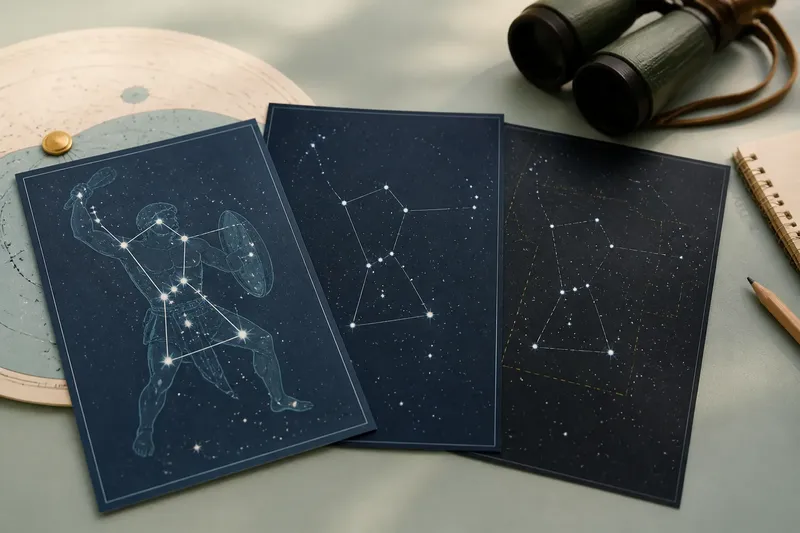
Constellation lines are choices made by people looking at the same stars, not threads drawn across the sky. When you compare different star maps, the dots tend to stay put while the lines and figures around them change. That distinction helps explain why constellations can be useful without being literal pictures written into space.
A constellation is an officially defined region of the sky as well as, in everyday conversation, a familiar pattern of stars. The figures that help us recognise those regions are inherited ways of organising what we see. You can use a traditional outline, a sparse guide or no connecting lines at all; each approach suits a different kind of skywatching.
Stars and outlines
The stars are physical objects at very different distances from Earth. A two-dimensional chart places their apparent positions on a flat page, but a line joining two charted stars does not mean they are close together in space. It simply directs the eye from one point of light to another.
Constellation figures turn a crowded field into something easier to remember. The familiar outline of Orion, for instance, uses a small group of bright stars to suggest a hunter. The stars themselves do not trace a hunter’s body: viewers supply the figure, and different cultures have connected the same or neighbouring stars in other ways.
That human element does not make the patterns arbitrary in the sense of being useless. A shared outline lets people point out the same patch of sky and learn a route to nearby stars. But it is worth separating three things: the stars’ visible positions, a culture’s interpretation of their arrangement, and the boundaries astronomers use to divide the whole sky into named regions.
Three ways to connect stars
Star maps and observing traditions tend to use one of three broad approaches. They differ less in the stars they show than in how much interpretation they place between the viewer and the sky.
Traditional figures
In a traditional figure map, lines join stars into a recognisable outline, often accompanied by an animal, person or object. This approach suits a beginner who wants a memorable shape to find again, or a family pointing out familiar patterns together.
Its strength is quick recognition: a few bright stars can act as anchors in a dark sky. Its limitation is that the picture can seem more fixed than it is. A printed line may be a modern convention, and another star atlas can connect the same stars differently or omit some connections entirely.
Minimal lines
A sparse map connects only a few stars, leaving much of the pattern open. It suits someone who wants enough support to orient the eye but prefers not to have a full illustration dictate what the stars are supposed to resemble.
This approach can also make a chart easier to read under a dim red torch, since fewer marks compete with the star symbols. The trade-off is that some constellations become less immediately recognisable, especially when their outlines depend on several less prominent stars.
Stars without lines
A line-free chart shows stars, names and perhaps constellation boundaries, but does not join the stars into figures. It suits experienced observers, people comparing star atlases, and anyone interested in how a pattern looks before an illustration imposes a familiar reading.
Without connecting lines, it takes longer to learn some shapes. In return, the viewer can notice different groupings, including small clusters that cross a traditional figure’s outline. This can be a useful way to explore the sky without treating one inherited drawing as the only possible one.
What a constellation names
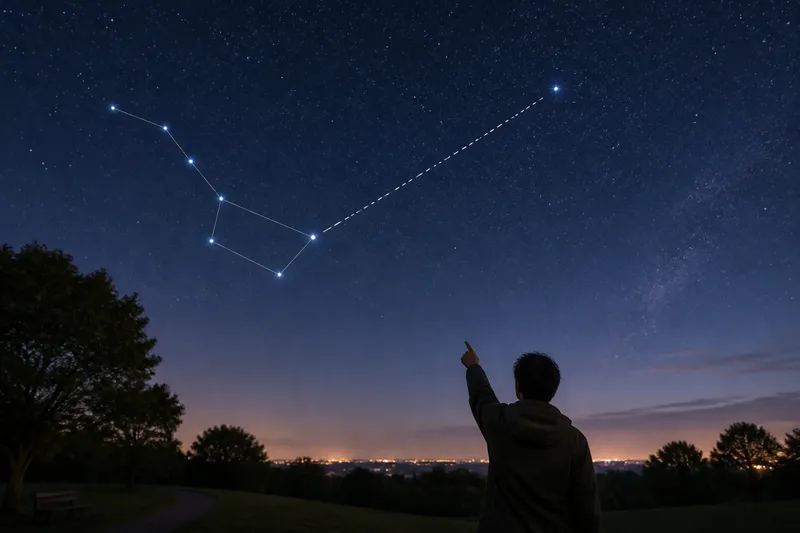
In ordinary speech, a constellation often means a pattern such as the Plough, the familiar part of Ursa Major used to locate other stars. In formal astronomy, a constellation is a defined area of sky, with boundaries that assign every point to one region or another. The visible pattern and the named region are related, but they are not identical.
This difference matters when a chart labels a star with a constellation name. The star is identified by the region of sky in which it appears, not because it must belong to the imagined figure in a physical arrangement. Boundaries help astronomers describe locations consistently, while outlines help observers recognise patterns. Those are separate jobs.
Star names and figures also carry cultural histories. A constellation map used in one tradition may group stars differently from a familiar European atlas, because communities developed distinct stories and systems for interpreting the sky. A modern chart may preserve one convention for practical consistency, but it cannot represent every sky tradition in a single set of lines.
Choose a map by purpose
Start with what you want the chart to do. If you are trying to recognise a bright pattern quickly, choose a map with clear, simple lines. If you want to explore the stars themselves or compare traditions, choose one with fewer connections, or keep a line-free chart beside a traditional one.
- For first recognition: Pick a chart with a handful of bold connections and clearly marked bright stars.
- For learning the whole sky: Look for constellation boundaries and labels as well as figures, so you can distinguish a pattern from its formal region.
- For comparing maps: Use two atlases with the same viewing direction and date, then notice which connections differ.
- For looking with children: Begin with a familiar outline, then invite everyone to suggest another shape without treating one answer as correct.
- For cultural context: Seek material that names the tradition behind its star figures, rather than presenting one set of stories as universal.
Say you are at a suburban park with a printed chart showing Orion’s outline, but the central stars are partly hidden by a tree. You could use the chart’s bright corner stars to orient yourself, then compare a line-free version to see which visible points belong to the same formal region. The expected result is not a perfect picture, but a clearer sense of which parts come from the sky and which from the map.
When comparing charts, check that both use the same orientation. A planisphere, phone app or paper atlas may be turned to match the sky in different ways; a familiar pattern can look unfamiliar if one view is reversed or rotated. The chart’s legend usually explains how it represents direction and star brightness.
Why do star charts draw different lines?
Are constellation lines official?
The lines joining stars are usually chart conventions rather than official boundaries. Astronomers use defined constellation regions to describe locations, while mapmakers decide whether and how to draw a figure within them.
Do the connected stars belong together?
They belong together as a pattern seen from Earth, but the apparent grouping does not mean the stars form a close physical cluster. They can lie at very different distances and have no special connection to one another.
Can I invent my own star figures?
Yes, you can connect visible stars into personal patterns for remembering or sharing what you see. It helps to distinguish your own figure from a traditional constellation name when you describe it to someone else.
Which map should a beginner use?
A simple chart with a few clear connecting lines is often easiest for learning familiar patterns. Choose one that also labels its orientation, then try a line-free view once the basic shapes are familiar.
Keep the choice visible
Constellation lines are most useful when you remember that they are guides for the eye. A traditional figure can help you find your way across a dark patch of sky; a sparse or line-free map can loosen the grip of that figure and make other groupings noticeable.
The constellation lines we inherit are therefore not a mistake to correct, but a mapping choice to recognise. Keep the chart that helps you look, and when a pattern seems inevitable, compare it with another map. The stars remain; the connections are yours to examine.