Why the Moon Changes Shape Over a Month
Why the Moon changes shape over a month becomes clear with one mental model: follow its sunlit half as the Moon moves around Earth.
Why the Moon changes shape over a month is easier to see if you imagine a lamp, a ball and your own viewpoint. The lamp stands for the Sun, the ball for the Moon, and you stand on Earth. The Moon does not grow or shrink as it travels; we see different portions of its always sunlit half.
Keep that simple arrangement in mind as you watch the sky. These six points explain what changes, what stays the same and why the familiar sequence takes shape.
1. The Sun lights one half
At any moment, sunlight illuminates roughly one half of the Moon. The other half faces away from the Sun and is dark. This division is not a permanent boundary painted onto the lunar surface: it moves across the Moon as the relative positions of the Sun, Moon and Earth change.
Imagine holding a ball in a room lit by a lamp. The side turned towards the lamp is bright, while the opposite side is shaded. If you walk around the ball, the lit region remains on the lamp-facing side, but its appearance from your position changes.
The Moon behaves in the same basic way. Its bright area is not produced by the Moon shining like a star; it reflects sunlight. What matters to an observer on Earth is how much of that illuminated area is also facing us.
2. Our viewpoint moves
The Moon travels around Earth, so the angle between the Sun, Moon and observer changes. From Earth, we see the Moon against the background sky, but our view of its sunlit half shifts as it follows its orbit. That changing angle creates the phases.
To picture it, place yourself at the centre of an imaginary circle and move a ball around you, keeping one side of the ball pointed towards a lamp outside the circle. At some positions, you face mostly the ball’s dark side; at others, you see a broad portion of its bright side. You do not need to turn the ball to make this happen. Your changing position around it is enough.
The Moon also rotates, but it rotates in step with its orbit around Earth. That is why observers see nearly the same face from one night to the next. The familiar face does not mean the Moon stays still; it means its rotation and orbit are closely matched.
3. The phase cycle
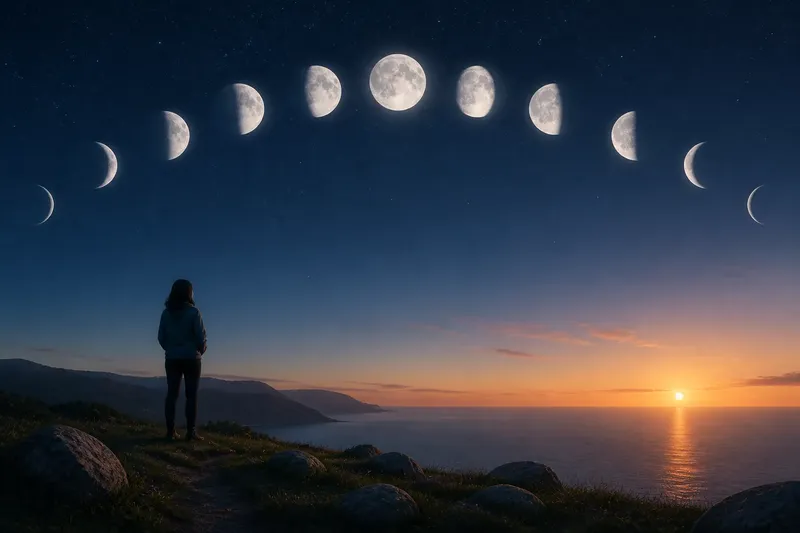
The phase names describe how much of the visible lunar disc appears illuminated. They mark a continuing cycle rather than separate kinds of Moon. Follow the sequence below from one new moon to the next:
- New moon: The Moon is near the direction of the Sun in the sky, so its sunlit half mostly faces away from Earth. It is difficult or impossible to see against the bright daytime sky.
- Waxing crescent: A slim bright curve becomes visible after sunset. “Waxing” means the illuminated portion we see is growing.
- First quarter: About half of the visible disc looks bright. The name refers to the Moon being roughly a quarter of the way through its phase cycle, not to the amount illuminated.
- Waxing gibbous: More than half of the disc is lit from our viewpoint, and the bright area continues to expand.
- Full moon: Earth is roughly between the Sun and Moon, so the Moon’s Earth-facing side is mostly sunlit. It rises around sunset and is visible through much of the night.
- Waning gibbous: The bright portion begins to shrink, though more than half of the disc remains illuminated from our viewpoint. “Waning” means decreasing.
- Last quarter: Again, about half of the visible disc is bright, now on the opposite side from first quarter.
- Waning crescent: A narrow illuminated curve remains before the Moon returns to new phase.
The sequence is gradual. Each night’s Moon may look only a little different from the previous one, but looking across several evenings makes the pattern easier to recognise. The exact time of moonrise and the phase’s appearance vary with where you are and when you look.
4. Position explains shape
Return to the lamp-and-ball model. When the Moon lies between Earth and the Sun, its bright side faces away from us, giving us the new moon. As it travels onwards, a small slice of the lit side turns into view. At the opposite side of its path, the Moon’s Earth-facing side is largely illuminated, producing a full moon.
At first and last quarter, the Moon is approximately at a right angle to the Sun as seen from Earth. We then see half of the lunar disc lit and half dark. The difference between the two quarters is not the amount of light but which side of the disc appears bright.
It is tempting to think Earth’s shadow causes the regular darkening and brightening. That is not what produces the phases. Earth’s shadow falls on the Moon during a lunar eclipse, which happens only when the bodies line up closely enough; ordinary phases arise from the Moon’s changing position and our viewing angle.
5. Direction is relative
Waxing and waning describe whether the visible illuminated area is increasing or decreasing, not whether the Moon is moving up or down in the sky. The bright edge may appear on different sides depending on the observer’s location, the time and the Moon’s orientation above the horizon.
For that reason, a drawing that always puts the crescent on one particular side can be misleading if treated as a universal view. Instead, compare the Moon with the Sun’s direction: a waxing crescent appears in the evening sky after sunset, while a waning crescent is generally seen before sunrise. Their changing times of appearance follow from their positions relative to the Sun.
Say you notice a thin crescent low in the west after sunset. Over the following evenings, you watch it become broader and remain visible later into the night. That is a waxing Moon: the Moon has moved along its orbit so that a larger part of its sunlit half faces you. The crescent’s position in the sky will also shift, but the expanding bright area is the clue to its phase.
6. Why does the Moon change shape?
Does the Moon make its own light?
No. The Moon reflects sunlight, and the Sun illuminates one half of it at a time. Its changing appearance comes from how much of that bright half is visible from Earth.
Does Earth’s shadow cause every phase?
No. Earth’s shadow causes a lunar eclipse when the Sun, Earth and Moon align closely. The regular phase cycle happens because the Moon moves around Earth and we see its sunlit side from changing angles.
Why do first and last quarter look similar?
In both phases, we see about half of the Moon’s disc illuminated. The bright portion appears on opposite sides because the Moon is at different parts of its orbit and the illuminated area is changing from waxing to waning, or vice versa.
Why can the Moon appear during the day?
The Moon is not restricted to the night sky. Depending on its position in the phase cycle, it can be above the horizon during daylight; its pale disc may be visible against the brighter sky when conditions allow.
7. Watch the change yourself
No special equipment is needed to follow the phases. Choose a clear view of the sky and notice the Moon’s outline and the time you see it. A notebook or a simple calendar can help you remember what changed between observations, but the essential tool is patience across several evenings.
Try asking two questions whenever you spot it: how much of the visible disc is bright, and is that bright area growing or shrinking? Those observations identify the broad phase without requiring you to memorise a diagram. If the Moon is not visible, its absence from your view does not mean it has vanished; it may be below the horizon or difficult to pick out in daylight.
The Moon’s monthly pattern is a changing view of a steady arrangement: sunlight falls on one half, and the Moon carries that lit half around Earth. Once you recognise the difference between the illuminated portion and the portion facing you, the phases become a way to read the Moon’s place in its journey rather than a series of changing lunar shapes.